


What does ‘too wet’ mean for hot composting?
Your compost heap is too wet if there is more water in the waste than there is energy (calories/heat) available to evaporate the moisture. If you do not balance a mix that is too wet, the waste will not rise above 40°C, it will start to smell, and liquid will flow out from the bottom of the HOTBIN.
Is my waste ‘too wet’ for hot composting?
Because you generally do not check whether the waste is ‘dripping wet’, it can be a challenge to find out if it is too wet. The waste is 'too wet' when the total percentage of water in your waste is above 75%. As a rule of thumb:
- Garden waste has a moisture content of 40-60%;
- Vegetable peelings have a moisture content of 70%;
- Food waste has an average moisture content of 80%;
- Foodstuffs such as salads, juice pulp, and cooked food have a moisture content of 90%.
How do I know if my waste is ‘too wet’ for hot composting?
- If a lot of liquid fertilizer (brown liquid) is leaking from the base plate; check if the water is actually seeping from behind the base plate. Ignore condensation and water dripping on the inside of the lid when you open it;
- The waste in the HOTBIN smells rotten, rancid, or like sewage (anaerobic);
- The temperature in the top layer does not rise above 30-40°C; poor aeration and a lack of new waste prevent the temperature from rising above 40°C. So, check these two elements as well.
How do I fix waste that is ‘too wet’?
- You can fix this by adding easily digestible waste to your mix. Paper and/or corrugated cardboard absorb excess moisture easily, and is the easiest and most obvious material to add. For more information on the ratios of shredded paper to ‘wet’ waste, check the page Help! I don’t have any shredded paper. Now what? Tip: avoid adding newspaper or cardboard from, for example, breakfast cereal boxes for this purpose. Because bacteria cannot easily digest this material, you will find these ingredients as a mushy mass in your final compost.
- In addition, always add a portion of wood chips to regulate and promote airflow within the HOTBIN. Remember: shredded paper is to balance the moisture content, and wood chips are necessary to create and maintain proper aeration. Both ingredients are essential for the effective heating of the HOTBIN and cannot be substituted for one another.
Step-by-step guide to fixing a HOTBIN that is too wet
Step 1: fix the top layer
-
Mix 8 handfuls (half a bucket or half a carrier bag) of (corrugated) cardboard or shredded paper into the top layer. Check if you have added at least 6 handfuls of wood chips to the food waste in the past few weeks. If not, add this now and wait 48 hours. After that, check if the temperature has risen above 40°C. If not, go to step 2 below.
Step 2: check the base layer
Open the harvest hatch and inspect the waste in the base layer. Look at the table below to see what your base layer looks and smells like. Have you found the right example? Great! Then follow the follow-up steps for that example. Are you still not sure? Send a photo to vragen@hotbincomposting.nl. We are happy to help you!
1) Aerobic and active base layer
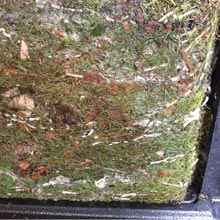
- Water is leaking but it does not smell rotten;
- Yellow/green material with recognizable waste that has not yet composted;
- Temperature below 40°C.
Note: your waste is still active, which is normal for waste that is about 6 weeks old.
Follow-up steps
If the waste in the top layer of the HOTBIN does not rise above 40°C within 2-3 days, the bottom is likely suffering from limited airflow.
- Add dry material: mix 1 to 2 carrier bags of paper into the base layer, along with 1 carrier bag of wood chips to improve airflow.
- Then add the contents back into the HOTBIN.
Tip: you might find it easier to spread the base layer out on a tarp, mix everything together, and then add it back in.
2) Anaerobic and active base layer
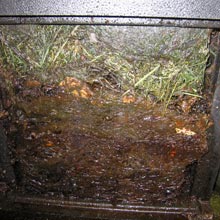
- Water is leaking;
- The waste in the base layer is yellow/green/brown/black with slimy and partially digested waste;
- It smells rotten
- Temperature below 40°C
Note: your waste needs attention to remove the odor and return to an aerobic status.
Follow-up steps
- Remove the base layer and place it on a plastic tarp to dry and aerate. This may take several hours.
- Mix 1 to 2 carrier bags of paper into the bottom layer, and add at least one carrier bag full of wood chips (if you have not done so before).
- Then add the contents back into the HOTBIN.
3) Aerobic and not active base layer
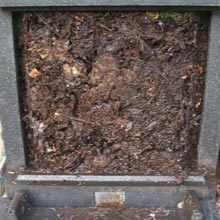
- Primarily brown, wet, boggy, sticky, and tacky pieces, temperature below 20°C, no odor or earthy odor.
- Normally, this is the case with waste older than 12 weeks.
Note: your waste has composted and is now stable. Heating up to 60°C is unlikely.
Follow-up steps
This compost is ready for use. Remove the compost immediately. If you leave this layer in, the layer will be further compressed, ultimately restricting airflow. This prevents the top layer from rising above 60°C.
Are you concerned that the compost looks too coarse and clumpy? Then read the article What does HOTBIN compost look and feel like?
4) Anaerobic and inactive base layer
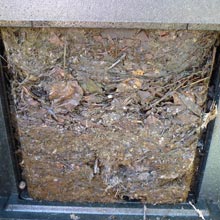
- Your compost looks like black sludge, water is leaking, and it has a strong sewage-like odor.
Note: your waste has composted anaerobically. It is now stable and unlikely to reheat to 60°C.
If you leave this layer in, the layer will be further compressed, ultimately restricting airflow. This prevents the top layer from rising above 60°C
Follow-up steps (options):
- Remove the compost and let it dry on a tarp. Turning it occasionally with a pitchfork helps aerate the waste and remove the remaining odor. Once dry, loosen it with a pitchfork. You can use the smaller pieces as mulch. Add the larger pieces back into the HOTBIN gradually as filler (must be dry!)
- Dig it in. When doing so, check that the compost is not active (step 2.2). Active waste attracts pests and robs the soil of nitrogen due to ongoing bacterial activity.
Still struggling?
Contact us! Send us a photo of your base layer and we will be happy to provide you with advice.


